
Where Bettas Come From and How Rice Paddy Habitats Shape Their Needs
By Conner Tighe
The betta in a plastic cup at the pet store comes from a long line of fish that lived in the slow, warm waters of Southeast Asia. That history explains a lot about how bettas behave, what they eat, and what they need from the water we give them. It has also been misread so often that people now use it to defend the smallest containers on the shelf.
Where wild bettas live
Betta splendens is native to Southeast Asia. Its home range centers on central Thailand, in the Chao Phraya and Mekong river basins, and wild populations have also been reported in Cambodia, Laos, and Vietnam. The Chao Phraya basin is also the type locality, the place from which the species was first formally described.
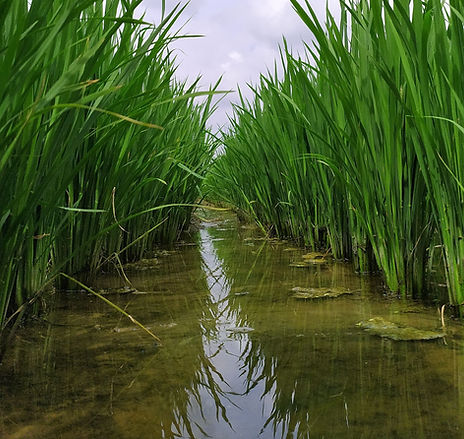
Wild bettas turn up in more kinds of water than most people expect: rice paddies, roadside ditches, drainage canals, marshes, ponds, and slow streams. What they have in common is still or barely moving water that is shallow, warm, and packed with plants. Floating weeds, rice stems, and fallen leaves fill the water, and as the leaves break down, they stain it tea brown. That color is tannins, not dirt.
What a rice paddy actually is
A paddy is a field deliberately flooded to grow rice, and the water is usually a foot or less deep during the growing season. It is shallow, but it is not a small pool. A single field can cover a large area, and fields sit side by side, linked by irrigation channels, ditches, and canals. During the rains, the whole system becomes one continuous stretch of shallow water, so a betta has room to move, settle where it likes, and leave where it doesn't.
Living in that kind of water shaped wild bettas in specific ways. The shallows heat up quickly, so warm-water fish stay near the surface. They eat insect larvae, small crustaceans, and other tiny animals, which is why a betta's mouth points upward and why a diet built on animal protein suits them better than plant matter. Males claim territory in dense vegetation and build bubble nests against floating leaves. A fish that evolved in a thicket of stems and leaf litter isn't built for a bare, bright, empty container.

The labyrinth organ
Shallow, warm, stagnant water holds little oxygen. Bettas get by with the labyrinth organ, a folded structure near the gills that lets them gulp air at the surface and absorb oxygen. People point to it when they say bettas can live anywhere, and the adaptation is real, since it lets a betta ride out low-oxygen water that would kill many other fish. It also means a betta needs open access to the surface, so a tight gap between the waterline and the lid, or a bowl packed with decorations that block the surface, works against the organ that keeps them going.
The puddle myth
The claim goes like this: bettas live in puddles in the wild, so they don't need much space in captivity. You hear it on care labels, from store staff, and in comment sections. It's wrong, and it's easy to see where it came from.
The myth has a real seed. Rice paddies are shallow, and the region has a pronounced dry season. As the dry months wear on, water drains and evaporates, and bettas can end up stranded in small leftover pools of warm, oxygen-poor water. Some fish wait out the dry spell until the rains refill the fields, and bettas have been reported moving short distances between pools when conditions allow.
That describes a fish surviving a bad stretch, not a fish living where it prefers to live. A person can get through a few days in a cramped emergency shelter, but nobody would call that what people need in a home. The puddle is the crisis. The paddy is the habitat.
The myth also confuses depth with size. A paddy that is eight inches deep can still be many square yards across, joined to more water in every direction. Wild bettas hold territories measured in feet and yards, not inches, and they spend their days patrolling, foraging, and sparring with neighbors.
What this means for a betta at home
Domestic bettas have been bred for generations, first for fighting in Thailand and later for color and fin shape, so they aren't identical to their wild relatives. Wild-type fish tend to be duller and shorter-finned. The basic needs haven't gone anywhere, though. A betta still wants warm, stable water, usually somewhere in the mid to upper 70s Fahrenheit, plus plants, hiding places, easy access to the surface, gentle flow, and room to explore.
Most reputable care guides set the minimum for a single betta at around 5 gallons, with a lid, a heater, and a filter that doesn't blow the fish around. Bigger is better, and a planted tank with floating cover comes closest to the shaded, leafy water these fish evolved in. Cups, vases, and small bowls offer none of that. They are cold, bare, and unfiltered, and a fish kept in one is surviving rather than thriving.
Paddies and wetlands across the region are being drained, polluted, and converted to other uses, and the IUCN lists Betta splendens as Vulnerable in the wild. The fish that gave us the aquarium betta is losing the habitat we like to quote when we talk about it.
Next time someone says bettas come from puddles, tell them where they actually come from: wide, warm, plant-choked fields of water with plenty of room to move.
This article was written by Conner Tighe.


Comments